
Republic County Deed Types
The Register of Deeds files far more than deeds. Mortgages, liens, oil-and-gas leases, city-addition plats, and powers of attorney all live in the same vault of Republic County property records. The deed image tells you what interest was conveyed, who the parties were, and what land was involved. The type label helps you read it in context. The full text still controls.
| Deed Type | What It Does | Common Use |
|---|---|---|
| Warranty deed | Conveys the stated interest with covenants | Ordinary sale |
| Quitclaim deed | Conveys whatever interest the signer has | Family or title cleanup |
| Trustee or executor deed | Transfers through a stated legal capacity | Trust or estate |
| Sheriff or tax deed | Records a legal-sale transfer | Foreclosure or delinquency |
| Correction deed | Corrects a prior recorded instrument | Name or description repair |
Each filing plays a different role. A deed conveys an interest, while a mortgage or lien burdens title without moving ownership. A release clears that claim. A plat maps how a tract was divided. A power of attorney shows who held signing authority. Keeping these Republic County deed records roles straight keeps a search from mistaking every related filing for a change of owner.
Republic County Deed Index Access
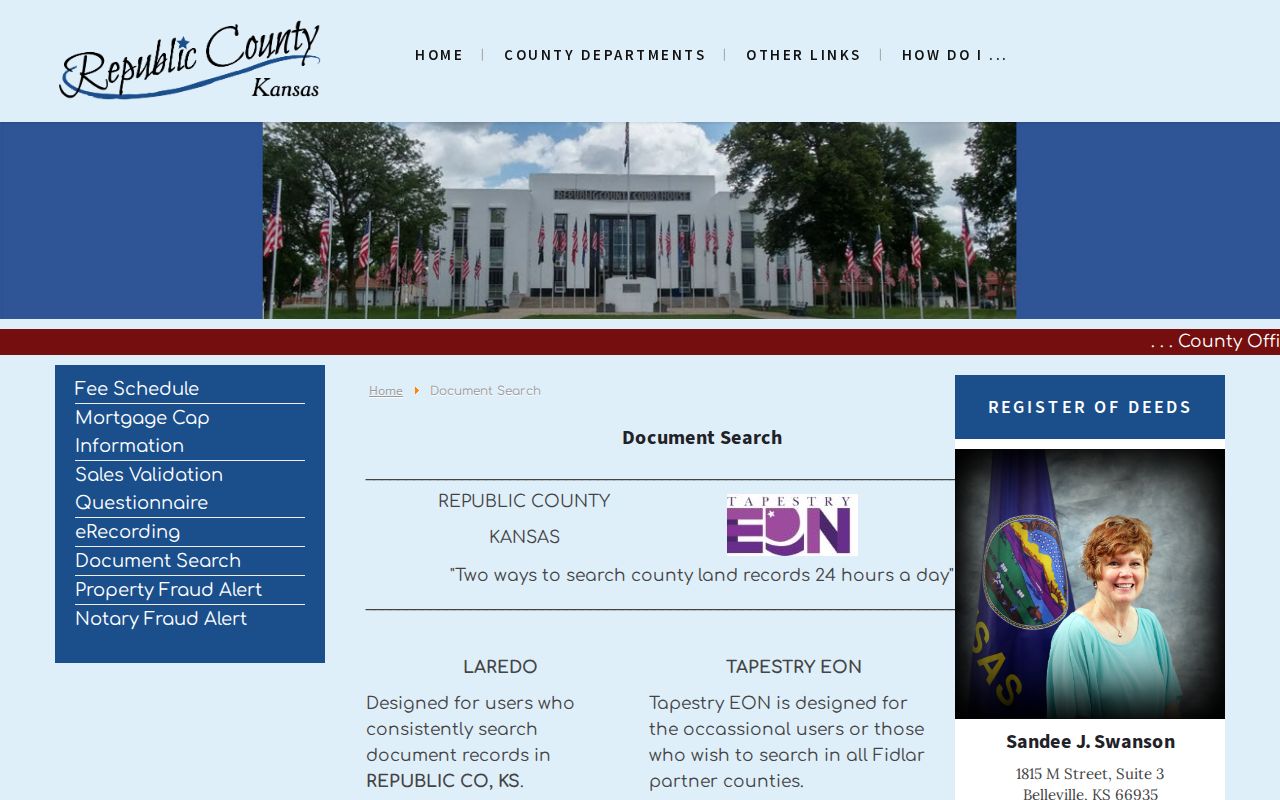
The county document-search page opens two Fidlar routes into the index. Laredo suits subscribers doing frequent work. Tapestry EON bills pay as you go. Tapestry lists $8.95 per search with images included, plus $1 per printed page. Check the terms before paying. Portal fees can change and never set the courthouse's copy rates. Searchable keys cover party names, date range, document type, consideration, section-township-range, subdivision and block, document number, and book/page. Cast a wide net first to catch spelling variants. Then tighten with dates and land terms. The official page does not state the online start year. The official Laredo and Tapestry access comparison shows both options side by side.
Both online routes trade convenience for depth, while the courthouse stays the source for certified copies, older volumes, and anything the modern indexes miss.
Republic County Grantor-Grantee Links
A grantor gives up an interest. A grantee takes it. Start your Republic County deed records chain at the newest vesting deed the record supports, logging both dates, the instrument or book/page reference, and the legal description. Then work backward. Search that grantee as a grantor, inspect every plausible hit, and accept a prior deed only when the land description agrees.
- Find the current party as grantee and open the likely vesting deed.
- Copy grantor, grantee, type, legal description, and any prior reference.
- Search the grantor as an earlier grantee, testing initials, name variants, trusts, and legal capacity.
- Follow book/page citations and move to courthouse volumes when online coverage ends.
- Grantor
- The party conveying the stated interest.
- Grantee
- The party receiving the stated interest.
- Chain of title
- The linked sequence of recorded transfers for the same land.
- Book/page
- A volume and page citation used to retrieve a filing.
Splits, combinations, replats, correction deeds, probate transfers, married names, and trustee signatures can all snap a simple chain. When only part of a tract moves, branch the worksheet. Give every instrument its own row and mark how each link was proven. Record execution date, recording date, instrument type. Add each party's role, consideration or exemption notation, source image, and confidence. Say "document-confirmed" only when the image and legal description match. Reserve "index-only" for a bare search hit. "GIS-lead" for map data. "Historical-lead" for an atlas name. Those labels keep a loose Republic County deed records lead from posing as a proven link.
Republic County Legal Description Checks
The Register of Deeds cautions that recorded legal descriptions differ from mapping descriptions. Property searches and tax statements carry the mapping versions. Keep both. Town land may run by addition, subdivision, lot, and block. Rural land may run by section-township-range, quarter section, government lot, or metes and bounds. A steady address proves nothing about a tract staying whole. After a split, combination, or replat, compare the deed language with GIS. Preserve punctuation, directional terms, and prior references exactly. For title or boundary reliance, the instrument and qualified professional work outrank any tax map. Trust and estate transfers deserve extra care. Search the trustee and trust name, or the executor and estate name. The index may file one event under different party forms. A death alone never creates a new deed. Probate may bridge the gap. So may an affidavit, a transfer-on-death instrument, joint-tenancy language, or a representative deed. Court records explain the event, while the recorded conveyance supplies the land-record link.
Republic County Recording Quality Clues
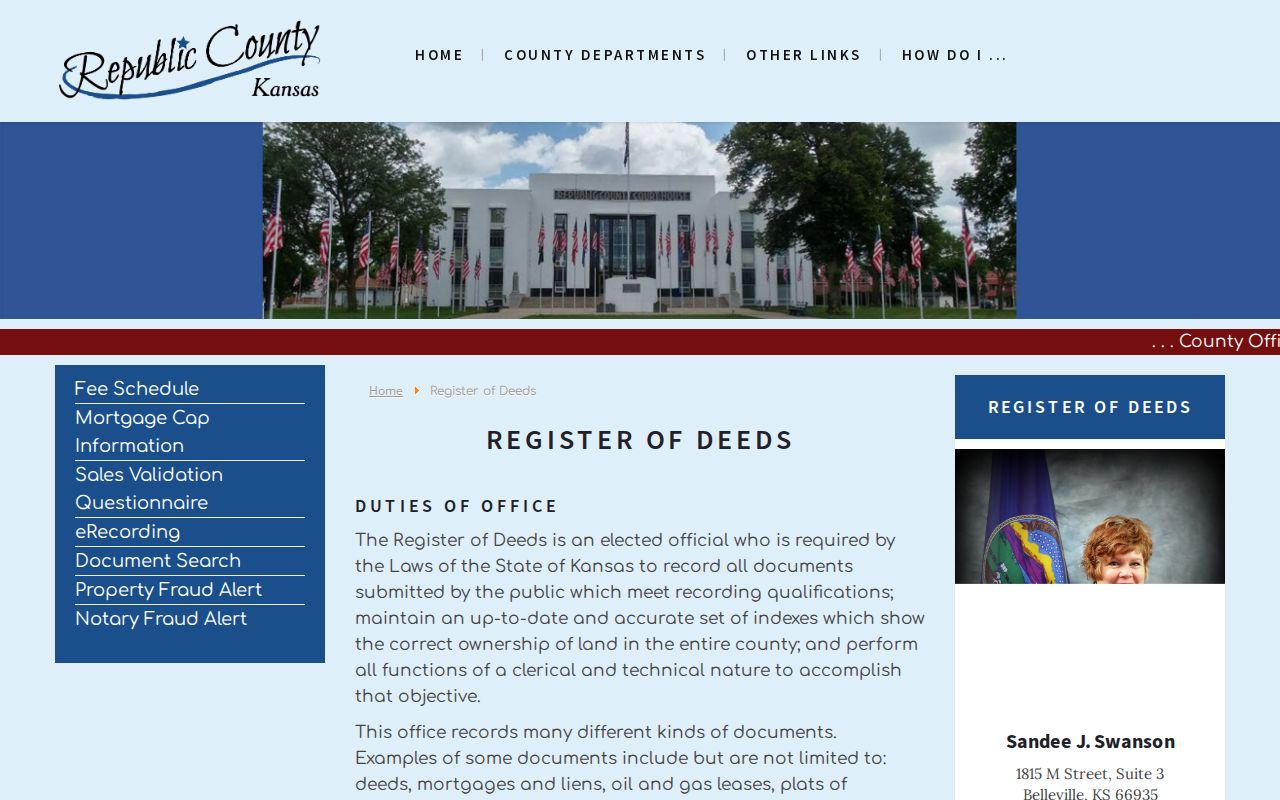
The recorder demands a three-inch top margin on the first page. A defective legal description can trigger added-page cost or rejection. So can a faulty notary acknowledgment. A missing Sales Validation Questionnaire or exemption number can cause the same problem. Unprinted names under signatures or too little stamp space can also trigger rejection. Those rules explain why a correction deed shows up in Republic County property records. A second recording can appear for the same reason. The Sales Validation Questionnaire gathers parties, consideration, sale facts, use, legal description, and split data. It is a valuation companion, not a deed. Some transfers are exempt, and K.S.A. 79-1437g sets a misdemeanor penalty of up to $500 for a false value. Never read a blank public price field as zero consideration. The recorder's official filing guidance spells out the current requirements.
The checklist explains corrected or delayed entries without turning an index oddity into an accusation.
Republic County Manuscript Deed Records
Republic County was organized on February 27, 1860. The Register of Deeds holds nineteenth-century manuscript records. It also holds federal patent deeds signed by a president. That says nothing about the first year available in Laredo or Tapestry. The office publishes no missing-volume list. For an older chain, contact the office or work at the courthouse. The 1904 Standard Atlas at Kansas Memory yields township, town, and surname leads. So does the 1884 landowner-map index. Treat historical names as context until tied to recorded Republic County deed records.
Coverage gap. Republic County holds 1800s manuscripts, but its public pages do not state how early the online index or images begin.
Republic County Recording Name Alerts
Republic County offers a free Property Fraud Alert service. A subscriber picks a name to monitor. When a recorded document lists that name as a party, the county sends notice by phone or text. The alert is a tripwire, not a shield. It does not block filing, prove fraud, or replace title insurance.
Treat any alert as a prompt to look closer. Review the image and legal description first. Common names generate false hits, so weigh party capacity, parcel details, signatures, and the notary block together. The recorder can help with record location, but real concerns belong with a lawyer or law enforcement.
Request Republic County Deed Copies
Certified or plain copies come straight from the courthouse. Contact Sandee J. Swanson at 785-527-7238, or visit 1815 M Street, Suite 3, Belleville. Hours run weekdays, 7:30 a.m. to 4:30 p.m. Bring the instrument number or book and page if you have it. Otherwise, supply the parties, a date range, and the legal description. Paid index routes may also supply online images.
Confirm the cost before you order by mail. The current fee schedule sits in a PDF the recorder publishes, so ask the office for the copy and certification total up front. Broader open-record requests may carry additional charges or require advance payment.
Recorded, not guaranteed. Republic County deed records locate filed instruments but do not guarantee marketable title or expose every unrecorded interest.
Some deed questions outgrow a records search. A purchase, probate, foreclosure, lien, or boundary dispute can call for a title opinion. For that, turn to a Kansas attorney, abstractor, or title professional.