
Compare Republic County Property Value Types
Name the number before comparing anything. Republic County and Kansas sources separate appraised market value, assessed value, and sale consideration rather than offering one universal property value.
| Value Type | What It Means | Where It Is Recorded |
|---|---|---|
| Appraised or market value | The Appraiser's estimate under mass-appraisal methods | Appraiser record and annual notice |
| Assessed value | Appraised value multiplied by the Kansas ratio for the property's class | Assessment and tax records |
| Sale consideration | The amount or exempt-transaction context tied to a transfer | Deed and Sales Validation Questionnaire when applicable |
| Annual county total | Certified value summary excluding state-assessed utilities | County yearly value summary |
Kansas sets the ratios by class. Residential property is assessed at 11.5 percent of appraised value, commercial and industrial at 25 percent, and agricultural land at 30 percent of use value. Match the official class, not the appearance.
Understand Republic County Assessed Value Math
Appraised value times the class ratio equals assessed value. That is the tax base. The assessed figure feeds the tax calculation, though special assessments and the levy belong to the tax-account story, and unlike parcels should not be compared until classification is confirmed.
Four terms do most of the work. Assessed value is the ratio-adjusted tax base. Appraised value is the county's estimate of market value; the assessment ratio is the Kansas percentage assigned by class, and reassessment is the recurring review that places a new annual value on the roll.
Agricultural land is valued by use rather than market comparison. A residence or commercial tract with a similar assessed figure may still sit in a very different tax position.
See How Republic County Estimates Property Value
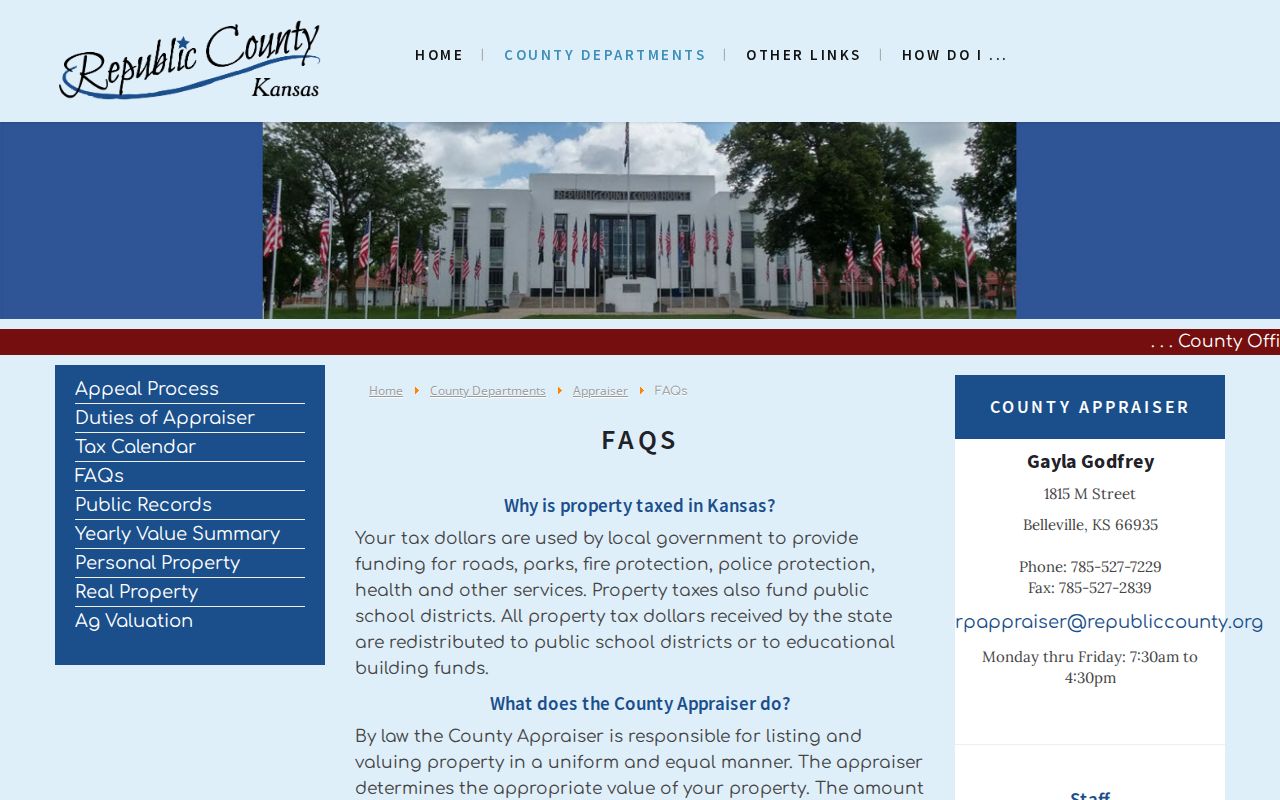
The Appraiser relies on three approaches. Comparable sales weigh relevant market transfers, the cost approach tallies land and improvements with depreciation, and the income approach reflects earning capacity where the property type supports it. A single sale never controls the result. The official Appraiser FAQ explains the methods and the ratio framework in the county's own words.
Read the guidance, then return to the parcel record. There the class, characteristics, and value year give the numbers meaning.
Place Republic County Property Value in Context
Mass appraisal applies consistent models across whole groups of property. A private appraisal answers one assignment on one effective date. The gap matters when condition, access, utilities, topography, agricultural use, or an unusual improvement makes a parcel hard to match against its neighbors. Check what the county record reports first. Value differences may come from data, not the market.
Plenty of events can shift an individual result. These include a class change, new improvement, parcel split, combination, corrected characteristic, or model update. Compare the parcel across years and keep the effective year beside each figure. A countywide total cannot explain one tract.
Locate a Republic County Property Value
The Appraiser portal offers a public-user path to value lookups, and the fields it presents can vary by session. Contact the Appraiser if a session fails.
- Find the parcel by situs address, PID, CAMANUM, Quick Ref ID, or legal-description clues.
- Record appraised value, assessed value, class, effective year, and displayed update date.
- Check the deed and sale-validation context before treating consideration as a comparable sale.
- Compare like classes and similar property characteristics for the same valuation year.
- January 1
- The annual Republic County valuation date.
- March 1
- The stated timing for value and classification notices.
- Six-year cycle
- The physical inspection cycle, distinct from annual valuation.
Date Every Republic County Assessed Value
The Appraiser values property annually as of January 1 and follows a six-year physical inspection cycle. The annual value can change even when the parcel has not reached its next inspection year.
Research captured a portal message saying the database was last updated September 4, 2026 at 4:26 p.m. That timestamp is an access clue, not a fixed revaluation year and not proof that every sale had reached the roll. Recheck it whenever current value matters.
Note: Republic County publishes annual value summaries, but no official fixed countywide last-revaluation year was located.
Compare Republic County Sale and Property Value
A recorded deed may carry a consideration amount. The Kansas Sales Validation Questionnaire adds context. It asks about family or corporate relationships, auctions, short sales, estate or judicial transfers, partial interests, personal property, financing, and adjoining-property buyers. Those answers mark sales that are not arm's length.
Some transfers are exempt, including gifts, certain trust transfers without consideration, corrections, sheriff deeds, cemetery lots, and some quitclaim deeds used to clear title. A blank amount never proves the land worthless. Nor is a stated amount a clean comparable.
Use Republic County Value Summaries Carefully
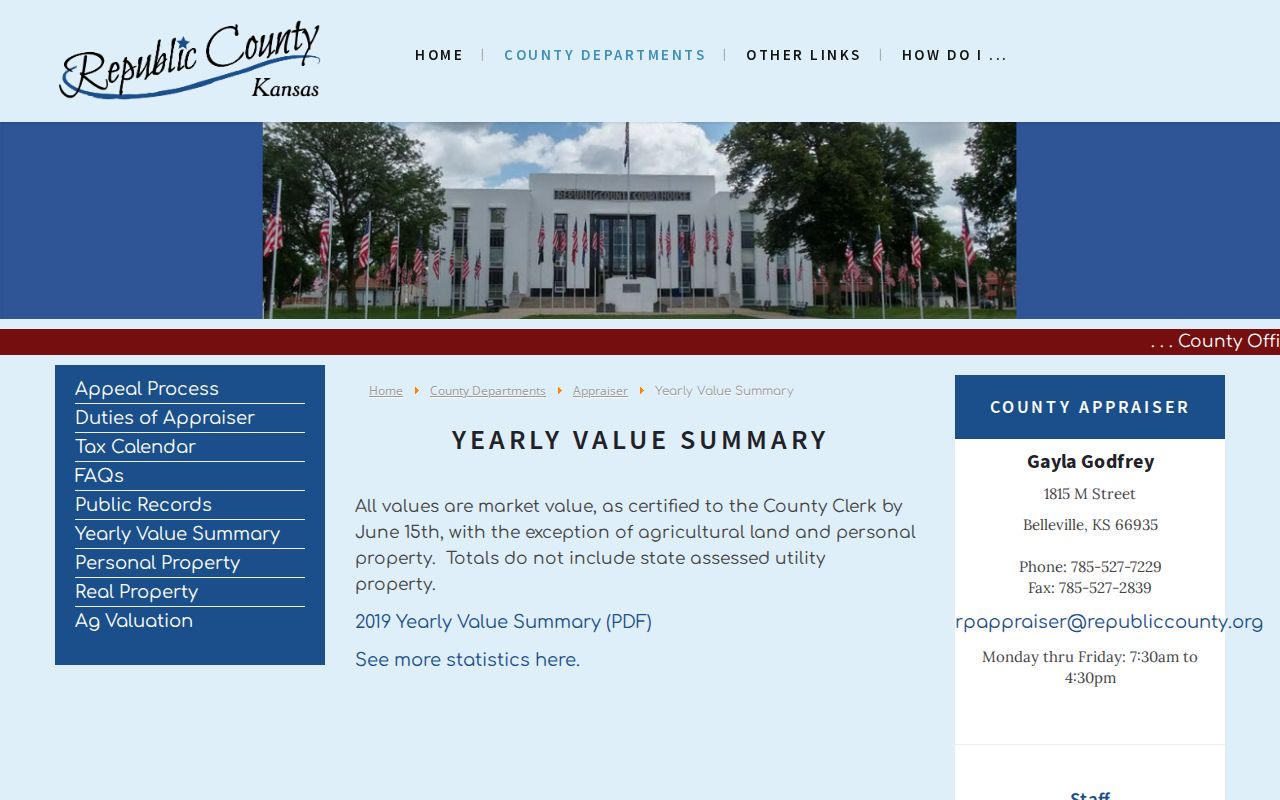
The county's yearly value summary presents certified annual totals and excludes state-assessed utility value.
A countywide summary gives context, not a parcel estimate. Go back to the subject record for class and year.
Read Republic County Sale Conditions
The questionnaire sorts sales by property type. Types include single-family, agricultural, farm or ranch with residence, mineral, condominium, vacant, apartment, and commercial or industrial. Each type gets its own frame of reference. It asks about more than price. Changes since January 1, included personal property, and delinquent taxes all appear on the form. That context matters. It explains why transfer consideration and annual appraised value should never be compared as bare numbers.
Take a family conveyance, estate transfer, short sale, auction, partial interest, or adjoining-property purchase. It may not reflect what an unrelated buyer would pay for the real estate alone. Financing and personal property muddy things further. Keep the form's context with the deed date whenever sale information is used.
Know What Republic County Property Value Cannot Prove
An assessed value is a tax-system figure. An appraised value is a mass-appraisal estimate, and neither one is a guaranteed offer, title report, permit finding, or private appraisal. GIS and aerials add context, not sale predictions.
Assessment is not a sale appraisal. Republic County assessed value supports taxation and reflects a statutory ratio. It is not what the property would necessarily sell for and does not replace an independent appraisal.
For bills, exemptions, due dates, and protests, see the Republic County property tax records page. Those topics sit outside the valuation story.